 Stairs with more than five steps need a railing. This is stated in many local building codes, which your responsible building authority can provide you with information about. But a handrail makes sense as a stair safety device from as little as three steps. The height of the handrail is important: At least she has to 90 cm (Measured perpendicularly between step and handrail) be. Where small children live, are supposed to have stairs with more than 150 cm fall height over railing rungs with max 12 cm distance. This is also recommended for lower stairs. Avoid horizontal bars: They only tempt you to climb!
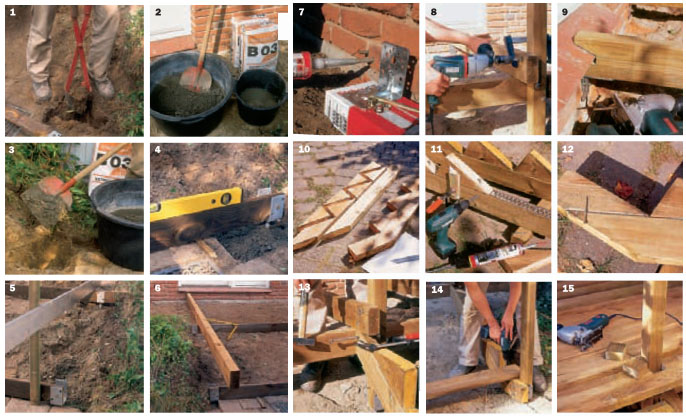
1 Measure the positions for the platform/railing supports and raise them approximately 80 cm deep.
2 Put screed concrete (for example from Quickmix) earth-moist in a ratio of about three parts concrete to one part water.
3 Then fill the foundation holes with it and insert the post shoes.
4 A temporarily attached board and a spirit level help to align the post shoes horizontally on each level.
5 The difference in height from the landing to the ground in front of the stairs can be measured using a straight edge, to determine the number and height of the steps.
6 So that the stairs lead to the house at right angles, the post shoes of the platform must also be precisely aligned laterally. Use a squared timber to take the gauge.
7 Heavy-duty brackets with injection dowels and threaded bolts are mounted on the house as support beam bearings.
8 Exactly aligned in height and scale, the crossbeam of the pedestal, which runs parallel to the house, is screwed to the posts, as are the supporting beams, with carriage bolts and nuts that have been bolted through.
9 In the area of the front door, the beam head is cut out in the form of the Sol bank.
10 To mount the step boards, saw right-angled triangles to size 16 (step height) x 28,5 (step depth) x 32,5 cm from.
11 Then glue it to the stair stringers with PU glue and use a clamp, Holzklotz, interleaved paper and a wood screw.
12 Additionally secure the lowest “saddle” from below with a screw.
13 The stair stringers are mounted on the posts, again with carriage bolts.
14 Simply attach the steps with two screws at each end.
15 + 16 At intervals of approx 1 cm, the "planks" of the platform are screwed onto the supporting beams. Use the jigsaw for notches.
A Pressure treated horticultural lumber is well protected from pest infestation and weathering. However, the impregnation did not penetrate the wood, therefore have to…
B … all cut surfaces, that arise when the components are sawn to size, treated with a wood preservative.
C Particular dangers threaten the wood due to soil moisture. Therefore, posts should not be buried, but better set up with concreted post shoes. This keeps the wood above the ground. This should be avoided, that the post hits the bottom of the post shoe all the way.
PRESSURE IMPREGNATION,
called KDI for short, makes garden wood durable. In a closed system (in the vacuum process) Salts are pressed into the wood under pressure as a protective agent.
The impregnation can no longer be washed out after fixing and provides preventive protection against the effects of the weather, insects, wood-destroying fungi and soft rot. LOCK BOLTS Mostly available in galvanized quality and for outdoor use in stainless steel, they are ideal for bolting horticultural timber: After pushing through the screw shank, the square can be hammered into the wood below the head, which effectively prevents the screw from turning when the fastening nut is tightened on the opposite side. In hardware stores, the screws are usually in lengths of 20 to 120 mm available. In some catalogs they are called "pan-head screws with square insert".